The History of the End of the World Train
How Ushuaia's End of the World Train grew out of the prison railway that carried convicts to cut timber from around 1909–1910 until 1947, and how part of its corridor became a tourist train in 1994.
The End of the World Train runs on part of the corridor of Ushuaia’s prison railway, the Tren del Presidio, which carried convicts out to cut timber in the forests west of town from around 1909–1910 until the prison closed in 1947. The tourist train has run since 1994 on new, narrower track with modern carriages, so you ride a reconstruction, not the original. The audio guide tells the prison story on every ride, including the National Park & End of the World Train Tour, which includes the train in every booking (from $50, 4.5 from 1,166 reviews).
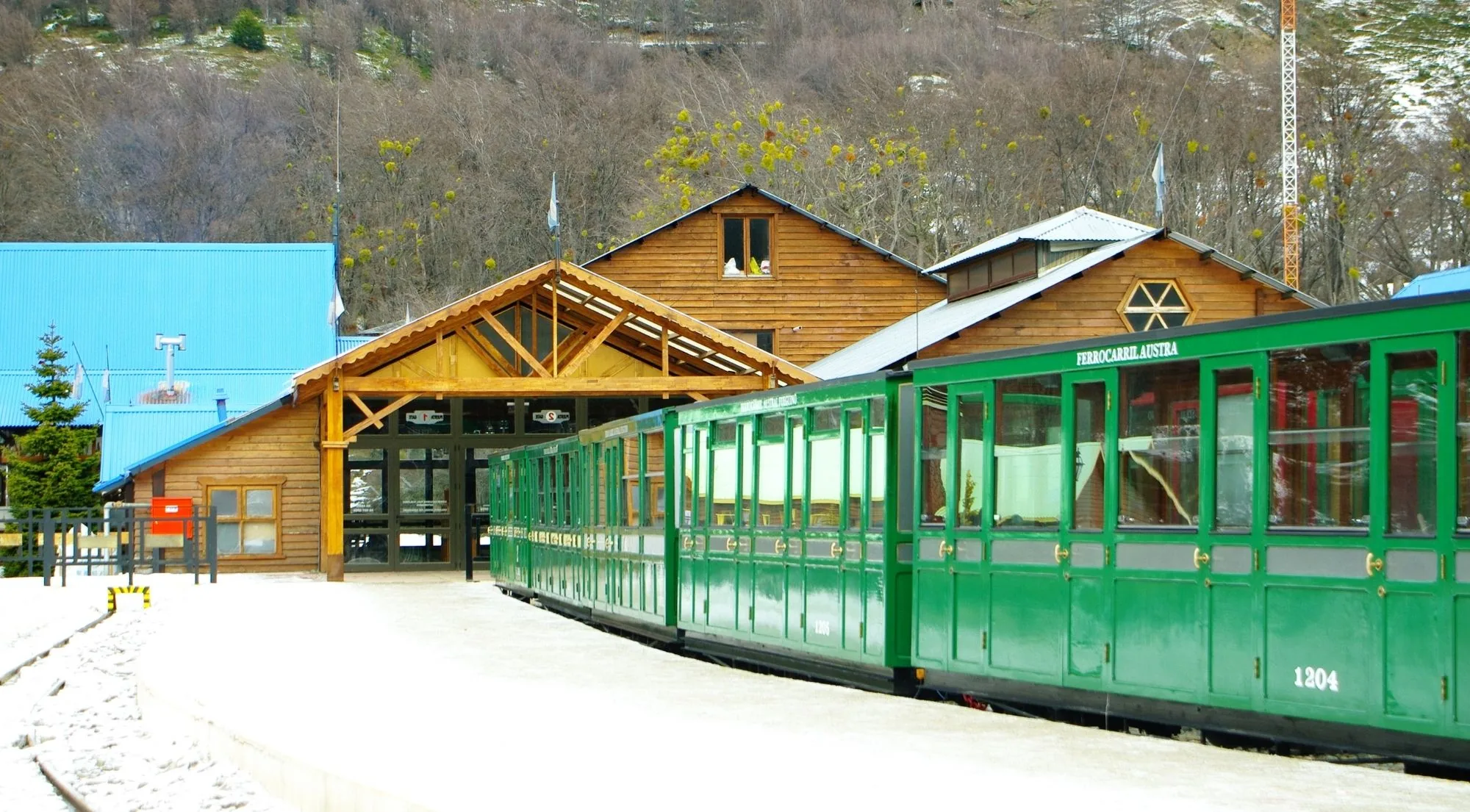
Know the story before you board and the ride makes more sense. Without it, you get a short heritage railway through good Tierra del Fuego scenery; with it, you can see why Ushuaia grew where it did.
Check Availability
End of the World Train history at a glance
| Historic railway | Tren del Presidio, the Prisoners’ Train (Tren de los Presos) |
| Prison | Foundation stone laid 1902; closed 1947 |
| Steam railway | From around 1909–1910 until the prison closed in 1947 |
| Purpose | Carrying prisoners, firewood, timber and building materials |
| Historic destination | The forests on the slopes of Monte Susana and around |
| Modern tourist train | Running since 1994 |
| Modern route | About 7 km, at 500 mm gauge |
| Starting point today | End of the World Station, about 8 km west of Ushuaia |
| Main theme | Ushuaia’s former prison colony and its forced labor |
| On board today | Heritage railway, scenery and an audio guide in ten languages |
Why was there a prison in Ushuaia?
The Argentine Navy set up a permanent base here in 1884. The national government then made Ushuaia a penal colony, partly to populate the island and to assert Argentine sovereignty at the far south of the country. The prison moved from Isla de los Estados, where the climate and sanitary conditions were too hard, and the foundation stone of the national penitentiary was laid on its present site in 1902.
The prison and the town grew together. Prisoners worked on construction and infrastructure, and the colony brought guards, officials and services to an isolated corner of Tierra del Fuego.
You can still see that history in Ushuaia today, above all at the Maritime Museum and Former Prison in the city. The railway was part of the same system.
Why was the prisoners’ railway built?
The prison needed large amounts of:
- firewood
- timber
- construction materials
The forests outside Ushuaia had all three. Prisoners were sent from the prison to the slopes of Monte Susana and other wooded areas to fell trees and gather materials, and the railway moved prisoners, timber, supplies and building materials between the forest and the settlement far faster than carts could.
When did the Prisoners’ Train operate?
Published histories describe an early wooden-railed line from about 1902, replaced around 1909–1910 by a steam railway on 600 mm Decauville track that ran roughly 25 km out to the forests. It worked until the prison closed in 1947. The railway’s operator does not give a start year; it says only that the line ran for decades until the prison closed.
Those dates matter because they separate the historic railway from today’s attraction. The line was never built for sightseeing; it was part of the penal colony’s working infrastructure.
Who built the railway?
Official Argentine records say the Prisoners’ Train was built by inmates of Ushuaia’s high-security prison. The same prisoners then rode it out to the timber-cutting.
Modern marketing likes the romance of a steam train at the end of the world. The original line was part of a prison labor system. Keep that in mind on the ride.
What did the prisoners actually do?
The railway took prisoners into the forests around Ushuaia. Their work included:
- felling trees
- collecting timber
- moving construction materials
- supplying firewood
The wood went back by rail to the prison and the settlement, so the line supplied both the prison and the growing town.
Was the railway originally the same as today’s route?
No. The tourist train uses part of the historic corridor, not the whole original system. The old line started at the prison in town; today’s ride starts at the End of the World Station, about 8 km west of Ushuaia, and runs about 7 km toward Tierra del Fuego National Park along the valley of the Río Pipo.
So when people say the modern train “follows the prisoners’ route”, that is broadly true. It is not a full recreation of the original railway from the prison. Our route guide sets out exactly where today’s line runs.
What happened in 1947?
The prison closed in 1947, and the convict service ended with it. Without the penal colony and its timber trade, the railway had lost its purpose. Most published histories add that the 1949 earthquake damaged the track and that the line shut for good in 1952; the operator’s own history does not mention either date. After that, the old line fell out of use.
How did the railway become a tourist attraction?
The modern End of the World Train grew out of a project to bring part of the old route back for tourism. According to official Argentine documentation, Tranex Turismo drew up a tourism project in 1993 to rehabilitate embankments once used by the Prisoners’ Train. The operator says the recovery of the route began in 1994 as a private initiative led by Enrique “Quique” Díaz, and the tourist train has run since that year. Local owners took over the company in 2017.
The railway’s purpose changed completely:
from prison labor and timber haulage → to history and tourism.
Is today’s train an original prison train?
Not in the literal sense. Today’s service runs tourist locomotives and purpose-built passenger carriages on new 500 mm track, narrower than the prison line’s 600 mm. The steam engines include the Ing. L. D. Porta, first named Nora, and Camila, built in England in the mid-1990s.
The railway recreates the historic journey along part of the old corridor, but it is a modern heritage line. You are not boarding a train preserved as the prisoners rode it in the early 20th century; you are riding a reconstruction built around that history.
Why is it called the End of the World Train?
Ushuaia has long sold itself on its position at the southern tip of the Americas. The train’s modern name, Tren del Fin del Mundo, plays on that, and puts the railway alongside the region’s other “end of the world” sights. The old line is still remembered as the Tren de los Presos, the prisoners’ train.
What parts of the old story can you still see today?
The landscape matters most. The train still passes through ground tied to the prisoners’ railway:
- forest
- the Pipo River valley
- peatland
- the old railway corridor
- the land cleared by timber-cutting
At the End of the World Station you can see historic photographs and railway material, and the audio guide on board explains how the railway and Ushuaia’s prisoners were connected. Our guide to the train’s stations and stops lists every historic point on the line.
What is the tree cemetery?
Along the route you pass the tree cemetery (cementerio de árboles): fields of stumps beside the river, most no more than about half a meter high. They are what remains of close to half a century of convict logging, and the forest has not grown back the way it was.
It is the one place where the history is right outside the window.
What is Burnt Bridge?
Puente Quemado, or Burnt Bridge, is another historic point on today’s route, where the railway crosses the Pipo River. The remains of the old wooden bridge lie below the current track, a reminder that the tourist train follows a much older corridor.
Why does the train stop at Macarena?
Today La Macarena is a scenic stop of about 20 minutes, near Cascada La Macarena. Historically, the railway says, trains stopped here to take on water for the steam locomotives.
You can usually get off, look along the valley and take photographs before the train moves on.
What did Ushuaia look like during the prison era?
Ushuaia today is a busy gateway for Patagonia and Antarctica. The prison-era settlement was very different: remote and small, shaped by government institutions, the prison, the navy and the administration, with slow communications and a harsh climate.
The prison was not just another building in town. It was one of the institutions that made Ushuaia grow.
Did prisoners build parts of Ushuaia?
Yes. Prison labor went into local construction and infrastructure, and timber and stone cut by prisoners supplied building work in the settlement.
That wider role is why the railway mattered: it was part of the supply system for an isolated town.
Should you visit the former prison museum too?
If the history interests you, yes. The train and the former prison fit together well. The railway shows you the landscape and the route of the prisoners’ labor; the museum shows you the institution itself and gives far more detail on Ushuaia’s penal history.
The Maritime Museum and Former Prison is in the old penitentiary in town. Adult tickets cost ARS 50,000 from 1 February 2026 and are valid for two consecutive days, and it opens 10:00 to 20:00 with last entry at 19:30, so you can split the visit around the train.
A history-focused day in Ushuaia runs:
Maritime Museum and Former Prison → End of the World Train → Tierra del Fuego National Park
Is the train mainly history or scenery today?
Both. Without the scenery, the story would feel like a museum exhibit on wheels. Without the history, the route would be a short scenic train ride. If you are still deciding, our verdict on whether the End of the World Train is worth it weighs the two.
How much of the historical story is told onboard?
Every carriage has an audio guide in ten languages: Spanish, English, Portuguese, Italian, French, German, Chinese, Japanese, Korean and Russian. The narration covers the prison, the prisoners’ railway, the forest work and the landscape outside, so the ride makes sense even if you know nothing about Ushuaia’s past before you board.
Is the End of the World Train historically authentic?
In short: historically connected, but rebuilt for tourism.
Authentic elements:
- part of the historic corridor
- the penal-colony history
- the real link to prison labor
- the landscape itself
Modern elements:
- today’s locomotives
- the passenger carriages
- the tourist station
- the audio guide
- the café and shop
- the premium classes
Describe it as a heritage railway on a real historic route, not the original Prisoners’ Train preserved unchanged.
Frequently asked questions
Was the End of the World Train originally used by prisoners?
Yes. The modern railway follows part of the corridor of the old Prisoners’ Train.
When did the original prisoners’ railway operate?
The steam railway ran from around 1909–1910, after an earlier wooden-railed line, until the prison closed in 1947.
Why did prisoners use the train?
To travel out to work in the forest and to carry timber and other materials back to the prison and the town.
Did prisoners build the railway?
Yes. Official Argentine records state that inmates built the Prisoners’ Train.
Is today’s train the original one?
No. The modern service is a rebuilt heritage railway on part of the historic route, with new track, locomotives and carriages.
When was the modern tourist railway developed?
A tourism project to rehabilitate sections of the old corridor was drawn up in 1993, and the tourist train has run since 1994.
Does the train start at the old prison?
No. Today’s service starts at the End of the World Station, about 8 km west of Ushuaia.
Can you still visit Ushuaia’s former prison?
Yes. The old penitentiary now houses the Maritime Museum and Former Prison in town, open daily from 10:00.
The bottom line
The End of the World Train exists because of Ushuaia’s prison. The original line was a working railway, built and used by the penal colony to carry prisoners into the forest and bring timber and materials back to Ushuaia, from around 1909–1910 until 1947. Decades later, part of its corridor became today’s tourist train.
The ride is far more comfortable and polished now, but the landscape and the history are real. Knowing them changes what you see: instead of forest and mountains, you see why the railway is there at all, and how closely Ushuaia’s growth was tied to the prison.
To ride it, the operator’s End of the World Train ticket (Turista class, $50, 4.8 from 18 reviews, a small sample so far) covers the train alone, and a park tour with the train adds the lakes and Lapataia Bay. Our guide to which End of the World Train tour is right for you compares them; check your date before you book, because departure times change with the season.
Ride the Southernmost Railway in the World
Pick a departure, add your national park ticket, and board a steam train on the line prisoners once worked. Free cancellation up to 24 hours before on the GetYourGuide ticket.
Check Availability & Book