The End of the World Train in Winter
Riding the End of the World Train in winter: snow on the line, heated carriages, the 9:45, 12:15 and 15:00 departures, about 7 hours of daylight in June, what to wear and how to plan the park.
The End of the World Train runs every day through the winter, in heated carriages, and the line is at its most dramatic when snow covers the track and the forest. The cost is the short day: about 7 hours of daylight at the June solstice, a national park that closes at 18:00, and roads that need snow tires or chains. If you want the park as well as the train, take the morning departure.
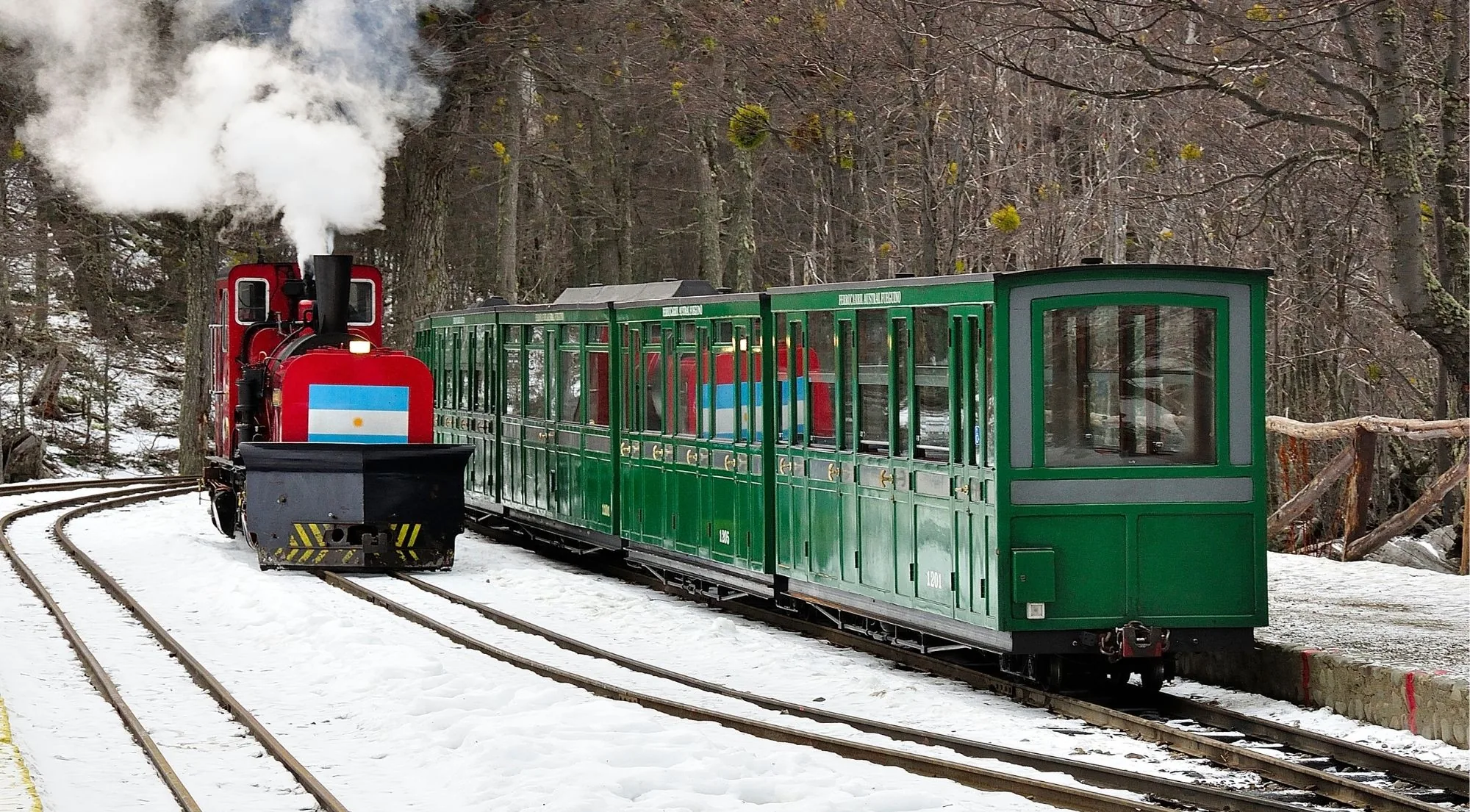
Winter is a good time to ride. The steam hangs in the cold air, the lenga forest turns white, and because you sit in a heated carriage, you see the snow without standing in it for long. What takes more planning is everything around the ride: which departure you take, how you reach a station 8 km out of town on winter roads, what you wear for the outdoor stops, and how much of the park you can still see before dark.
Check Availability
Winter at a glance
| June to August | |
|---|---|
| Does the train run? | Yes, every day; it cancels only in extreme weather |
| Departures | 9:45, 12:15 and 15:00 (May to August timetable) |
| Carriages | Heated |
| Daylight | About 7 hours 12 minutes at the June solstice, rising to about 10 hours by the end of August |
| Mean high / low | About 4.5 to 5.7 °C / 0 to 0.5 °C |
| Days with snowfall | About 9 to 11 a month |
| National park hours | 9:00 to 18:00 (April to September) |
| Driving | Snow tires or chains required |
| Getting off at the park end | The railway recommends staying on for the round trip |
Is the End of the World Train open in winter?
Yes. The railway operates 365 days a year, holidays included, and says a departure is cancelled only when extreme weather makes the trip unsafe. Ordinary snow is part of the winter ride, and the railway promotes the season for it.
Does the train run during snowstorms?
Normal snow is part of the winter ride, but no service is immune to severe weather. A storm can still cancel a departure if the railway judges it unsafe, slow the road to the station, cut visibility, or disrupt a park tour or transfer.
That makes the train one of the easier things to fit into a winter trip to Ushuaia. Bad weather can still slow the road out to the station or close parts of the park, so treat winter as a reason to plan, not a reason to skip it.
What is the train like in winter?
The ride itself is the same as in any month: about 1 hour 45 minutes out and back on 7 km of narrow-gauge line from Estación Fin del Mundo, up the Río Pipo valley and into Tierra del Fuego National Park, with a 20-minute stop at La Macarena and 10 to 15 minutes at the park station. The audio guide tells the prison story in ten languages.
What changes is the landscape. On a winter ride you may see:
- snow on the track and on the forest floor
- snow on Monte Susana and the surrounding mountains
- the tree cemetery’s stumps poking through white ground
- frozen or partly frozen ground and streams
- low winter light, and mist or cloud that comes and goes
On a still, cold day, the steam from the locomotive is the picture most people come for.
Is there guaranteed snow?
No. Ushuaia is snowy in winter, but you cannot count on fresh snow on the track on your exact date. Temperature, recent snowfall, wind and rain all change it, and a white valley one day can turn patchy a few days later.
The climate normals show how likely it is:
| Month | Days with snowfall | Mean high °C | Mean low °C |
|---|---|---|---|
| May | 4.8 | 6.9 | 1.7 |
| June | 9.3 | 4.5 | 0.5 |
| July | 10.6 | 4.6 | 0.2 |
| August | 10.2 | 5.7 | 0.1 |
| September | 7.7 | 7.6 | 1.0 |
Ushuaia 1991–2020 normals. A day with snowfall is not the same as snow lying on the ground, but the pattern is clear: if a snowy ride is the main reason you are booking, July and August give you the best chance, June is close behind, and September often still has snow.
When is winter in Ushuaia?
The main winter is June to August, and snow is likely from June to September. The railway’s own winter timetable runs from 1 May to 31 August, and the park keeps its shorter winter hours, 9:00 to 18:00, from April to September.
Winter departure times and daylight
What are the winter departure times?
From 1 May to 31 August, trains leave at 9:45, 12:15 and 15:00. The railway’s FAQ gives 12:30 for the midday train while its fares page and the city tourist office give 12:15, so check the time on your ticket. From 1 September the timetable moves back to 9:30, 12:00 and 15:00. The station opens at 8:45 in winter, and check-in is mandatory 45 minutes before departure. The schedule guide has every season.
The timetable is not the hard part in winter. Daylight is.
How much daylight is there in winter?
| Date | Sunrise | Sunset | Daylight |
|---|---|---|---|
| 15 May | about 9:15 | about 17:40 | about 8 h 25 min |
| 21 June | about 10:00 | about 17:10 | about 7 h 12 min |
| 15 July | about 9:50 | about 17:30 | about 7 h 40 min |
| 15 August | about 9:00 | about 18:20 | about 9 h 25 min |
| 31 August | about 8:20 | about 18:50 | about 10 h 30 min |
Calculated for Ushuaia, local time. Twilight adds roughly 45 minutes of usable light before sunrise and after sunset.
Two things follow. Around the June solstice, the 9:45 train leaves a quarter of an hour before sunrise, so the outward ride is in twilight and the light comes up while you are in the valley. And the 15:00 train is back at the station around 16:45, less than half an hour before a midwinter sunset, with the park closing at 18:00. An afternoon train in June or July leaves no time for the park afterwards.
Best winter departure
Morning departure
The best choice if you want to continue into the park, care about photographs, want the most daylight, are driving yourself, or want room to adjust if the weather turns. It is the only winter departure that leaves a full afternoon for the park.
Midday departure
Good if the train is your main plan for the day, you would rather skip the early start, or you are on a compact half-day tour. In midwinter it leaves a couple of hours of light for the park.
Afternoon departure
Works if the railway is your only plan, your park visit is on another day, and you are happy to finish near sunset. For a first winter visit, take the earliest train you can get.
Staying warm
Is the train heated?
Yes. The railway describes its carriages as heated, in both Turista and Premium. Once you are seated, the ride is comfortable in any weather, which is what makes it such an easy winter outing compared with a hike.
You still spend time outside: on the platform, getting on and off, at the 20-minute stop at La Macarena and the short stop at the park station, and in the park afterwards if you go on.
What should you wear?
Dress for the outdoor stops, not for the carriage:
- a warm base layer
- a fleece or mid layer
- an insulated jacket
- a waterproof outer layer
- warm trousers
- gloves and a hat
- warm socks
- waterproof boots with good grip
Mean highs in midwinter are around 4.5 to 5.7 °C with lows near freezing, and wind makes it feel colder than the thermometer says. Layers let you open up in the heated carriage and close up again at the stops. The railway allows no luggage on board, so carry only what you will wear.
Do you need snow boots?
You do not need heavy expedition boots, but waterproof footwear with good grip makes a real difference. Snow, slush and ice make the platforms and paths slippery, and if you continue into the park you may be walking on snowy trails, wet boardwalks and icy viewpoints.
Is winter better for photography?
Often, yes. Snow makes the railway look like nowhere else, and winter gives you pictures that summer cannot:
- the locomotive against white forest
- steam hanging in the cold air
- snow on the track and the platforms
- the mountains behind the valley
- low-angle light, even at midday
- blue hour before the morning train and after the afternoon one
The catch is that cloud and falling snow can hide the mountains. Winter photography here is about atmosphere, not guaranteed clear views. Our route guide shows where the views open up along the line.
Is the train better in winter than summer?
It depends on what you want from the day.
Winter is better if you want:
- snow on the track and the forest
- the steam and the cold, “end of the world” feel
- railway photographs that look different from everyone’s summer ones
- a dramatic outing that needs no hiking
Summer is better if you want:
- long days, with about 17 hours 20 minutes of daylight at the December solstice
- easier roads
- more time in the park, which stays open until 21:00 from December to February
- green forest and open trails
- easier hiking
The ride itself is arguably more memorable in winter. The whole Tierra del Fuego day is easier in summer. Our worth-it guide weighs the two seasons against the price.
The train and the national park in winter
Is Tierra del Fuego National Park worth combining with the train in winter?
Yes, but timing matters more than in summer. The park closes at 18:00, and some of it closes for the season: the Senda Costera, Pampa Alta, Hito XXIV and Cerro Guanaco trails are open from November to April only, and access to Ensenada Zaratiegui may be closed or restricted depending on road conditions. The short Castorera beaver dam walk is open all year, and the walks around Lapataia Bay carry no seasonal closure.
A winter park day can still take in Lapataia Bay, Lago Acigami, forest viewpoints and short walks through snow. With the light this short, a coordinated day is especially useful.
One winter rule changes how you ride. The rest of the year you can get off at the park station, walk the nearby trails and catch a later train back. In winter the railway recommends staying on for the full round trip, because the national park closes the points near the terminus in bad weather. If you want the park, see it by road.
Is it better to book a combined tour in winter?
For many visitors, yes. Winter adds snow, icy roads, short days and changeable weather, and a combined tour handles the hotel pickup, the road out, the train timing, the park stops and the drive back.
The National Park & End of the World Train Tour is the most reviewed option on this site, with a 4.5 rating from more than 1,100 reviews. It picks you up at your hotel, puts you on the train and drives on to Lapataia Bay, Lake Roca and the Alakush visitor centre (our breakdown →). Check which train it uses on your date, because a winter morning departure gives you the most of the park. Every option is in which End of the World Train tour is right for you.
Traveling independently still works, especially with a rental car, if you are comfortable driving on snow and ice. The train-only option is the operator’s own Turista ticket, from $50 per person on GetYourGuide.
Getting to the station in winter
Can you drive to the station in winter?
Yes, with care. Snow tires or chains are required in winter, inside the park and on the way there. Drive slowly, avoid sudden braking and steering, plan to drive in daylight, and stay off the road when visibility drops. The station has free parking.
If you are not used to snow and ice, take a taxi or a tour instead, especially if you have only one day, are traveling with children or have a fixed departure.
Is there a transfer in winter?
The railway runs no shuttle at any time of year. The station is 8 km from town, so a taxi or a tour is the easiest way to avoid winter driving. If your train time is fixed, arrange the ride, and the ride back, before the day rather than leaving it to the last minute. Our getting-there guide covers every option.
Who winter suits
Is winter good for families?
It can be very good. The train is easier for children than a winter hike: the carriages are heated, the ride is short, the snow keeps them looking out of the window, and there is little walking. The challenge is keeping them warm at the outdoor stops and between the car and the platform, so bring more layers than you think you need. Strollers cannot go on board.
Is winter good for older travelers?
Often, yes. The train gives you snowy Tierra del Fuego scenery without a difficult walk. The concern is not the ride but icy surfaces on platforms, at La Macarena and at park viewpoints. The railway has adapted carriages for travelers with reduced mobility; let it know when you book. Anyone with mobility issues should also check station access, the tour vehicle and the walking surfaces at each stop.
Along the line in winter
Will you see frozen waterfalls?
Possibly, but do not count on it. The waterfall at La Macarena and the streams along the route look different depending on the temperature: you may find flowing water, ice around the edges, partly frozen sections or snow-covered banks, and it changes from week to week.
Does the Macarena stop still happen in winter?
The 20-minute stop at La Macarena is part of the ride, with time to walk to the waterfall and the viewpoint. In snow and ice the path can be slippery, so how far you walk depends on the day and on your footwear. The bigger winter change is at the other end of the line, where the railway recommends staying on the train rather than getting off to walk.
What else can you combine with the train in winter?
Winter Ushuaia has plenty to fill the rest of your trip: a Beagle Channel boat trip, the national park, snowshoeing, sledding and skiing at Cerro Castor or on the slopes below the Martial Glacier, and lake tours along Route 3 north of town. The train works especially well on a day when you want something less strenuous.
Train + Beagle Channel cruise in winter
It can work, but the short day makes the timing tighter than in summer. Do not book the two back to back without a buffer, because weather can delay both the road and the boat. The National Park, End of the World Train & Beagle Channel Day packs the park, the train and a boat trip into one booking (our breakdown →, and the full-day combination page); check how its timings fit a winter day before you book.
Train + ski day
Usually not a good pairing. A ski day at Cerro Castor deserves its own day, and the train sits better beside the national park or a quieter day in town.
Is winter a quieter time?
Do not assume it is. Ushuaia has a real winter season built on snow and skiing, and Argentina’s winter school holidays fall in July. Weekends and holiday weeks can still fill trains, and the city tourist office notes that the morning trains are generally taken by agency groups. If your dates are fixed, book ahead.
What are the main winter disadvantages?
Short daylight
The biggest practical issue: about 7 hours 12 minutes at the June solstice, and the park closes at 18:00.
Weather uncertainty
Visibility can change quickly, and cloud can hide the mountains.
Slippery surfaces
Snow and ice make the platforms, paths and viewpoints harder going.
Driving conditions
Snow tires or chains are required, and the road out takes longer.
More clothing
You need proper winter gear even though the carriages are heated.
None of these is a reason not to go. They change how you plan the day.
What are the main winter advantages?
Snowy scenery
The biggest reason to choose winter.
Railway atmosphere
A steam train in snow looks the way people imagine this railway.
Comfortable sightseeing
You see a winter landscape from a heated seat, with no strenuous hike.
Distinctive photography
Winter gives you pictures that look nothing like summer’s.
A stronger sense of place
Cold, snow and short days suit a railway built to serve a prison at the end of the world.
Frequently asked questions
Does the End of the World Train run in winter?
Yes. It operates every day of the year, including through the winter, and cancels only when extreme weather makes the trip unsafe.
Does the End of the World Train run in snow?
Yes. Normal snowfall is part of the winter ride, although extreme conditions can still cancel a departure or slow the road to the station.
Is the End of the World Train heated?
Yes. The carriages are heated in both Turista and Premium.
Is winter the best time to ride the End of the World Train?
It is arguably the best season for snow and atmosphere, but not for daylight or easy logistics. Summer makes the whole park day easier.
What should I wear on the End of the World Train in winter?
Warm layers, a waterproof outer layer, gloves, a hat and waterproof footwear with good grip. The carriages are heated, but the stops are outdoors.
Can I combine the train with Tierra del Fuego National Park in winter?
Yes, and it is one of the best ways to see the area in winter. Take the morning train, because the park closes at 18:00, and expect some trails to be closed until November.
Should I drive myself in winter?
Only if you are comfortable driving on snow and ice; snow tires or chains are required. Otherwise use a taxi or a tour.
Is an afternoon train a good idea in winter?
It can be if the train is your only plan. In midwinter the 15:00 train is back less than half an hour before sunset, so if you want the park afterwards, go earlier.
The bottom line
The End of the World Train is not just available in winter. Winter may be when it looks its best: snow on the track, steam in the cold air and a warm carriage moving slowly through a white valley. The trade-off is a short day and harder roads.
If you go in winter:
- take an early departure if you also want the national park
- dress for snow and wind, and wear boots with grip
- skip self-driving unless you are used to winter roads
- stay on the train for the round trip, and see the park by road
- check the train time on your ticket, and arrange your ride back before the day
For fares and classes, see the tickets and prices guide.
Ride the Southernmost Railway in the World
Pick a departure, add your national park ticket, and board a steam train on the line prisoners once worked. Free cancellation up to 24 hours before on the GetYourGuide ticket.
Check Availability & Book