The End of the World Train Route
Where the End of the World Train goes: the 7 km line from the station outside Ushuaia to Estación Parque Nacional, the La Macarena stop, and why it never reaches Lapataia Bay.
The End of the World Train runs 7 km west from its own station 8 km outside Ushuaia to Estación Parque Nacional, inside Tierra del Fuego National Park, stopping once at La Macarena for the waterfall and the viewpoint. The round trip takes about 1 hour 45 minutes. The line stops well short of Lapataia Bay and Lago Acigami, which are several kilometers further on and reachable only by road.
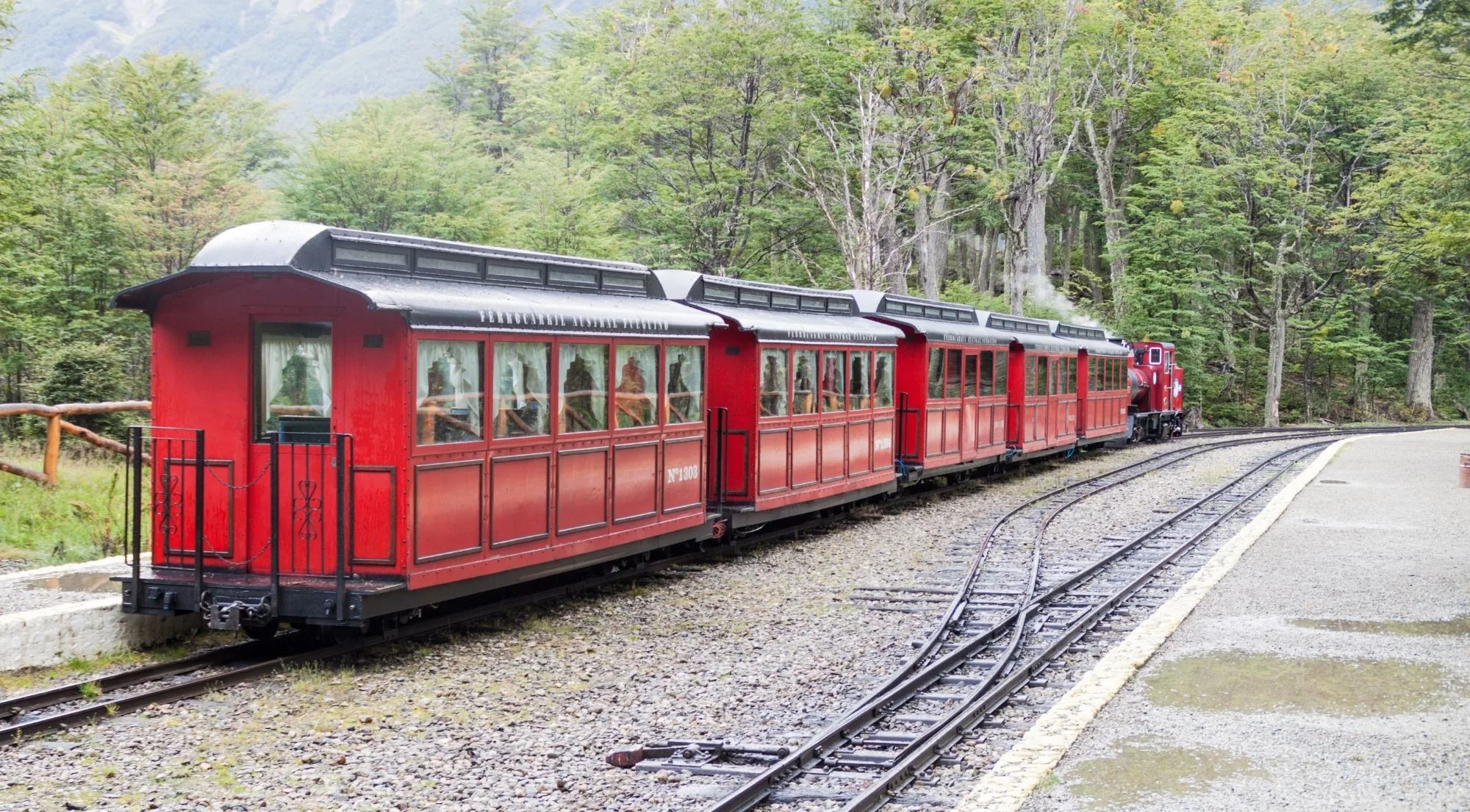
Where the line goes is the part of this ride people most often get wrong. The train crosses into the national park, which is why every rider needs a park ticket, but it covers only the park’s first corner. This guide follows the route stop by stop, says what you see from the window in each season, and names what the train leaves to the road.
Check Availability
The route at a glance
| Boarding station | Estación Fin del Mundo, National Route 3 at km 3065 |
| Distance from central Ushuaia | 8 km west, 1 km before the park gate |
| Length of the line | 7 km |
| Gauge | 500 mm |
| Stations | Three: Fin del Mundo, La Macarena, Parque Nacional |
| Intermediate stop | La Macarena, about 20 minutes |
| Terminus | Estación Parque Nacional, inside the park |
| Round trip | About 1 hour 45 minutes |
| From the window | Río Pipo valley, lenga forest, peat bog, the tree cemetery, mountains |
| Not on the line | Lapataia Bay, Lago Acigami, Ensenada Zaratiegui |
You board only at Estación Fin del Mundo. You cannot join the train at the park end, and no road follows the track, so the 7 km between the two ends is train-only in both directions.
Where the line starts, and why it runs where it does
The station sits on National Route 3 at km 3065, 8 km west of central Ushuaia and 1 km before the national park entrance. That last kilometer matters: the station itself is outside the protected area, and the route crosses into it, so the park fee applies to every rider even on a return trip that never sets a foot down. It is ARS 40,000 for foreign visitors. Our getting-there guide covers the drive and where to buy the park ticket.
The railway runs no shuttle of its own, so you arrive by taxi, by car (there is free parking) or on a park tour that collects you in town.
The line follows part of a working railway, not a scenic route someone chose. Ushuaia’s national penitentiary was begun in 1902, and around 1909 to 1910 a steam railway on 600 mm Decauville track replaced an earlier wooden-railed line, running roughly 25 km out to the forests on the slopes of Monte Susana where inmates cut lenga for fuel and building timber. The prison closed in 1947, the 1949 earthquake wrecked the track, and the line shut in 1952. It reopened as a tourist railway in 1994, rebuilt along the valley of the Río Pipo at the narrower 500 mm gauge it runs on today. The corridor is genuine; the track under you is not the original.
Stop by stop along the 7 km
Out of the station and into the Río Pipo valley
The train leaves the station and drops into the valley of the Río Pipo within a few minutes. The ground here is open and low: peat bog, streams, tussock and thin stands of lenga and ñire, the two southern beeches that make up most of the forest at this latitude, with the mountains closing in on both sides. The audio guide, available in ten languages, starts on the prison story.
The tree cemetery
The stretch travelers remember is the cementerio de árboles, the tree cemetery — fields of stumps beside the river, most no more than about half a meter high, left by close to half a century of convict logging. It is the clearest thing on the route, and the one piece of scenery that is not scenery: the forest has not come back the way it was.
The line also passes the Cañadón del Toro and crosses the Pipo at Puente Quemado, where the remains of the old wooden bridge lie below the current track.
Estación La Macarena
The one scheduled stop, about 20 minutes. You get off, photograph the locomotive from the outside, and walk up to the Cascada La Macarena waterfall and the viewpoint over the valley, with Monte Susana and Cerro Guanaco behind it. Work in September 2025 added points of interest and step-free options here, and the Paseo del Valle walkway opened on 1 December 2025.
Twenty minutes is a stop, not an excursion. Plan on the waterfall, the viewpoint and photographs, and nothing that needs boots.
On to Estación Parque Nacional
After La Macarena the train climbs on through forest to the terminus inside the park, a new station building announced in February 2024. The train waits there about 10 to 15 minutes, subject to operations, before running back non-stop.
What the season changes along the line
The train runs 365 days a year, including in snow, and cancels only when extreme weather makes the trip unsafe. The carriages are heated; La Macarena and the park station are not.
Summer: December to February
Around 17 hours 20 minutes of daylight at the solstice, green lenga and mean highs of 12.5 to 13.6 °C. Snow days average under 1.5 a month. The park stays open until 21:00, which is what makes a full day after the train possible. It is also the peak: about 62% of the cruise season’s ship movements fall in these three months, so book ahead.
Autumn: March to May
The lenga turns red and gold, and the valley is at its most photogenic. Mean highs fall from 12.2 °C in March to 6.9 °C in May, and snow days climb from 1.0 to 4.8. Park hours shorten to 9:00–18:00 from April.
Winter: June to August
Snow on the track, the forest and the mountains, with 9.3 to 10.6 snow days a month and mean highs of 4.5 to 5.7 °C. Daylight is down to about 7 hours 12 minutes at the June solstice. The heated carriages earn their keep, and departures shift slightly later. The railway keeps its timetable; the park is where things shut — see what changes in winter.
Spring: September to November
Snow lingers early, then the valley greens up. Snow days fall from 7.7 in September to 4.4 in November, and mean highs rise from 7.6 to 11.5 °C. September has the lowest monthly rainfall of the year at 30.5 mm.
Where the line ends, and what it does not reach
Estación Parque Nacional is the end of the track. It sits inside Tierra del Fuego National Park, nowhere near the sights most people picture when they picture the park. The park covers 68,909 hectares; the railway touches its northeastern edge.
- Lapataia Bay is not on the line. It lies roughly 20 km from Ushuaia by road, at the point where National Route 3 ends — the signposted finish of the highway, marked Buenos Aires 3,079 km, Alaska 17,848 km.
- Lago Acigami, the lake still widely called Lago Roca, is reached by road.
- Ensenada Zaratiegui is reached by road too. It has its own car park, and the Senda Costera coastal trail starts there, 8 km and about 4 hours to the Route 3 and Lago Roca junction, open November to April only. The End of the World Post Office at Ensenada opened in December 1997 and is reported closed; travelers in recent years have found it shut, so do not build a visit around it. Winter access to Ensenada itself can be restricted depending on the road, and operators often skip the stop in the cold months.
So the train gets you into the park and then hands you back. If you want the lakes, the coast and the end-of-the-road sign, you need a vehicle after the ride.
The train’s corner of the park, and the rest of it
| The 7 km by rail | What the road adds | |
|---|---|---|
| Landscape | Río Pipo valley, peat bog, lenga forest, mountain backdrop | Lakes, Beagle Channel coast, bays |
| Named stops | La Macarena waterfall and viewpoint | Ensenada Zaratiegui, Lago Acigami, Lapataia Bay, the end of Route 3 |
| History | The prison railway, told on board in ten languages | The Alakush visitor center’s interpretation |
| Walking | A 20-minute stop | Short boardwalks and, in season, the Senda Costera |
| Effort | Seated, heated, step-free carriages available | Driving or a guide, plus time |
The park’s speed limit is 40 km/h and there are six car parks, at the entrance, Río Pipo, Ensenada Zaratiegui, Alakush, Lago Acigami and Bahía Lapataia. The Alakush visitor center has a cafeteria and restaurant, open daily 10:00 to 17:30.
For a first visit the two halves together make the day, which is what most park tours sell. Which End of the World Train tour is right for you compares them side by side.
How long the ride is, and what you see from the window
The official figure is about 1 hour 45 minutes for the round trip on the 7 km line, including the 20-minute stop. Per-leg times come from tour operators; the railway publishes only the total. Roughly an hour outbound with the La Macarena stop in it, and about 45 minutes back non-stop. Take the 20 minutes out and the outbound leg is nearer 40 minutes of movement. An hour on the way out is a short ride with a stop in the middle of it.
The scenery is quiet. Low forest, bog, streams, a river and a mountain skyline, seen slowly. The train is small, the gauge is narrow and nothing about the ride is dramatic; what carries it is the combination of the landscape, the steam locomotives and the story the audio guide is telling about the ground you are crossing.
Which side has the better view?
Neither, consistently. The line curves through the valley, so what is on your side changes as you go. You cannot book a side in any case: seats are not numbered, passengers board in order of arrival and staff seat each party together, so checking in early is what buys you a choice. Keep a camera to hand and expect to shoot both ways.
Walking the route instead
You cannot walk the railway as a substitute for riding it. The park’s own trails are separate walks, and several are short enough to add to a train day:
| Trail | Length | Time | Season |
|---|---|---|---|
| Castorera (beaver dam) | 0.2 km | 20 min | All year |
| Laguna Negra boardwalk | 0.5 km | 15 min | All year, currently under repair |
| Mirador Lapataia | 0.98 km | 30 min | All year |
| Paseo de la Isla | 1.3 km | 30 min | All year |
| Hito XXIV | 3.5 km one way | — | November–April |
| Senda Costera | 8 km | 4 h | November–April |
| Cerro Guanaco | 6 km one way | — | November–April, last entry 12:30 |
If hiking is the point of your day, spend it on the trails. If prison history and scenery with almost no walking is the point, the train is the better use of the morning. Our worth-it guide weighs the two against each other.
The full route in one day
The sequence most tours use, and the one to copy if you are driving yourself:
Ushuaia → Estación Fin del Mundo → train → Estación Parque Nacional → by road to Ensenada Zaratiegui, Lago Acigami and Lapataia Bay → Ushuaia.
The Tierra del Fuego National Park Tour runs that order in about 5 hours, with the train at the start and the road stops after it. Its listed price of $52 is the version without the train, and the option that includes the ride costs more — our breakdown has the checked figure. The National Park & End of the World Train Tour, the most-reviewed tour on this site, includes the train in every booking (our breakdown).
If you are driving, buy the park ticket online before you set off and allow the 45-minute check-in on top of the ride.
One way or return
Every ticket covers the full round trip, and there is no cheaper one-way fare. “One way” means getting off at Estación Parque Nacional and not riding back, which costs nothing extra.
Ride one way when someone is meeting you inside the park — which is what a park tour does, the guide waiting at the last station — or when you are continuing deeper into the park under your own steam. In spring and summer you can sometimes return on a later train, the 16:00, if space allows; it is not guaranteed.
Ride the return leg when the railway is the reason you came, when you have no park tour booked, or when your car or taxi is waiting back at Estación Fin del Mundo. Whichever you plan, check what your booking covers before you pay — the tickets and prices guide sets out the fares and the cancellation terms.
Frequently asked questions
How long is the End of the World Train route?
The line is 7 km long, and the official round-trip time is about 1 hour 45 minutes including a 20-minute stop at La Macarena. Operators put the outbound leg at about an hour with the stop and the return at about 45 minutes non-stop.
Where does the End of the World Train start?
At Estación Fin del Mundo, on National Route 3 at km 3065, 8 km west of central Ushuaia and 1 km before the national park gate. It is the only station where you can board.
Where does the train stop?
Once, at Estación La Macarena, for about 20 minutes — long enough for the Cascada La Macarena waterfall, the viewpoint and photographs of the locomotive.
Where does the train finish?
At Estación Parque Nacional, the terminus inside Tierra del Fuego National Park, where the train waits about 10 to 15 minutes before returning.
Does the train go all the way through Tierra del Fuego National Park?
No. It reaches the park’s northeastern corner and stops. The park covers 68,909 hectares, and the main sights need road transport after the ride.
Can you reach Lapataia Bay by train?
No. Lapataia Bay is about 20 km from Ushuaia by road, at the end of National Route 3, and no railway runs there.
Does the train go to Lago Roca?
No. Lago Acigami, still commonly called Lago Roca, is reached by road, as is Ensenada Zaratiegui.
Do I need a park ticket if I stay on the train?
Yes. The route enters the national park, so the entry fee is required even on a return trip where you never leave the carriage.
Ready to book?
The short version of the route: 7 km, three stations, one 20-minute stop, back where you started in about 1 hour 45 minutes — and a national park you have only just entered. If the railway and the prison story are what you came for, the return trip on its own is enough, and the operator’s own Turista ticket books it (our breakdown). If you want the lakes, the coast and the end of Route 3 as well, book a park tour with the train option and let the road do the second half. Compare them on the End of the World Train homepage or in which tour is right for you.
Ride the Southernmost Railway in the World
Pick a departure, add your national park ticket, and board a steam train on the line prisoners once worked. Free cancellation up to 24 hours before on the GetYourGuide ticket.
Check Availability & Book